
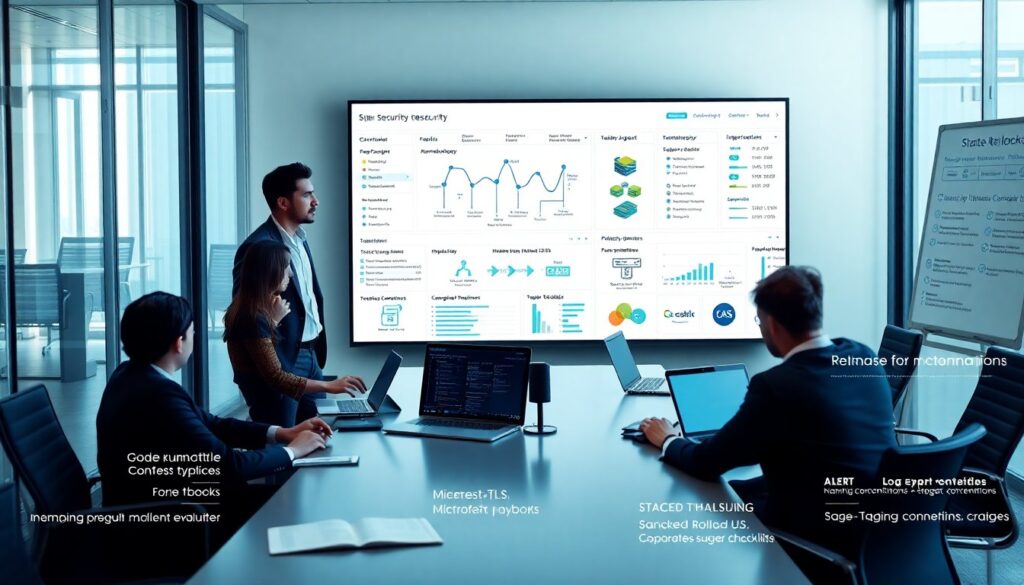
Core enterprise cybersecurity rangerTheme is a practical platform for protecting large networks. It gives administrators tools for policy, detection, and response. The guide explains fit, components, deployment, and monitoring. It aims to help IT teams evaluate and apply the solution. Readers will learn clear steps and configuration tips for 2026 environments.
Key Takeaways
- Core enterprise cybersecurity RangerTheme centralizes policy control and device management to enforce consistent security rules across large networks.
- The platform’s architecture includes a central controller, edge agents, and a management console that together enable scalable, secure policy enforcement and real-time telemetry collection.
- Deploy RangerTheme with clear naming conventions and staged rollouts, integrating it with CI/CD pipelines and existing SIEM and ticketing systems for automation and visibility.
- Monitor agent health, policy violations, and anomalies using structured logs and dashboards to enable swift incident response and automated containment actions.
- RangerTheme supports compliance with audit logs, role-based access controls, key rotation, and regular review processes for effective governance and regulatory adherence.
Why RangerTheme Fits Modern Enterprise Security Needs
Enterprises face many threats and they need a unified platform. RangerTheme offers centralized policy control and device management. It reduces configuration drift and it enforces consistent rules across sites. IT leaders praise the platform for clear rule models and fast rule propagation. The product integrates with identity providers and it supports zero trust workflows. Security teams gain visibility into assets and they view telemetry in a single panel. RangerTheme’s API allows automation and it links with existing SIEM and SOAR tools. The platform scales and it handles high throughput without degrading detection. Teams can map RangerTheme controls to standards such as NIST CSF and ISO 27001. The platform includes role-based access controls and it logs all admin actions for audit. For enterprises that must protect cloud and on-premise assets, RangerTheme supplies unified controls and consistent enforcement. They can deploy tags, groups, and templates and apply policies by role and location.
Core Components And Technical Architecture
RangerTheme ships with a central controller, edge agents, and management console. The controller stores policies and it distributes signed configurations. Edge agents enforce policies and they collect telemetry. The management console displays alerts, reports, and configuration status. RangerTheme uses a microservice design and it isolates functions by service. Each service runs in a container and it exposes secure APIs. The platform uses mutual TLS for service-to-service traffic and it encrypts stored secrets. RangerTheme supports distributed data stores for high availability and it uses leader election for controller failover. The agent uses local cache and it applies policies when connectivity drops. The product includes protocol parsers for common enterprise traffic and it supports custom parsers through a plugin model. RangerTheme integrates with identity providers via SAML and OIDC for single sign-on. It also integrates with LDAP for group sync. The platform provides a REST API and it includes SDKs for automation. It supports telemetry export to common formats and it ships connectors for major SIEMs. RangerTheme offers role separation so operators see alerts and admins manage policies. The platform supports encryption at rest and in transit and it provides key rotation features. These components combine to deliver consistent policy enforcement and measurable audit trails.
Deployment Best Practices And Integration Strategies
Teams should pilot RangerTheme in a nonproduction subnet first. They should onboard a limited set of agents and validate policy behavior. Administrators must define clear naming and tag conventions before wide rollout. They should map policies to business functions and they should test policy impact on workflows. Use staged rollout and monitor error rates and latency. Integrate RangerTheme with existing CI/CD pipelines and automate policy updates with CI jobs. Use the platform API to script policy promotion from test to production. Configure health checks and set alert thresholds to detect failures early. Use group-based policies to reduce per-host configuration. For cloud workloads, deploy the agent as a sidecar or as a host daemon depending on architecture. For hybrid setups, use a dedicated controller cluster in each region and a central management console for global oversight. When integrating with SIEM, forward raw telemetry and tagged events so analysts can correlate alerts. Connect RangerTheme to ticketing systems to automate incident assignments. Use the platform’s SDKs to build custom connectors where needed. Apply least privilege to management accounts and enforce MFA for admin logins. Keep agents current and schedule rolling updates to avoid downtime. Document all integration points and keep a runbook for common failures.
Monitoring, Incident Response, And Compliance Controls
Operators should collect agent health, policy hits, and anomaly counts. RangerTheme emits structured logs and it exports metrics to monitoring systems. Teams should create dashboards for agent coverage, policy violations, and top offenders. Set alert rules for sudden spikes in blocked traffic and for agent disconnects. The incident response team should define playbooks that reference RangerTheme alerts and they should map alerts to severity levels. Use automated containment actions where safe and permit manual review for high-risk changes. RangerTheme supports quarantine actions, flow blocking, and session termination. Teams should capture forensic artifacts from agents and they should push those artifacts to a secure store. For compliance, RangerTheme provides audit logs that show policy changes, admin actions, and enforcement timestamps. Map these logs to control requirements and export snapshots for auditors. Operators should perform regular access reviews and rotate management keys. Use the platform’s report templates to produce evidence for audits and to measure control effectiveness. Finally, run regular tabletop exercises that use RangerTheme alerts so staff practice response steps and they validate playbook accuracy.